Before 1200 books were produced on husbandry in Normandy, England and Italy. These were called ‘houseboundaries’ and were written by monks though based on reports by men with practical experience. In England in 1450, 20 000 out of 3 million population could read and write – mainly clerics. In France this was 10%. More of them could read than write. (Fossier; 2010; 335-40).
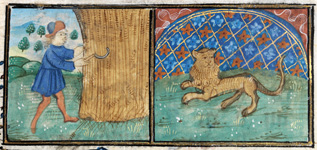 |
| This image is from the De Grey Book of Hours - there's a link to this on the right of the screen. There's quite a collection of 'working the land' images . |
Margaret of Austria (the god-daughter of Margaret of York) had a library of almost 400 books in Flanders. Louise de Savoie (mother of Francois I of France) chose books for her son and commissioned new works. Anne de Bretagne owned many manuscripts that stand out as having extraordinary calligraphic and artistic qualities some of which would have been commissioned by her. Recently facts have come to light about the collection of one of her close friends, Jeanne de Laval which I have looked at even though she was alive quite late in the Middle Ages (Legare; 1996; 209-10) as it was great to find an inventory of someone’s books.
Jeanne lived from1433 to 1498.She was the daughter of Guy XIV de Laval and Isabelle de Bretagne and as she married King Rene d'Anjou in 1454 and became Queen of Jerusalem and Sicily, Duchess of Anjou and Bar, and Countess of Provence she was rather higher up in the social scale than the type of person I wanted to be looking at. Her husband was an important patron of writers and illuminators, the theatrical arts and painting. His library was one of the largest belonging to a French prince during the fifteenth century. Jeanne owned rather less books but we know amongst these was a Psalter, her Book of Hours, and her Breviary which she left along with all her other books to the daughters of the Laval family, continuing the tradition of female education. She owned a Life of St Denis from 1317, in 3 volumes, and a Life of Saints. The article Reassessing women’s libraries in late medieval france : the case of Jeanne de Laval in Renaissance studies vol 10 no 2 contains the list of ten manuscripts that belonged to Jeanne. One of these is especially important - Les Aventures de Baudouiri de Gavre as this text is known only from this copy. It is illuminated with eighteen miniatures by an artist from the Loire valley and dates from around 1470-80. It is in the Bibliotheque Nationale on Paris. (Legare; 1996; 210 - 221.) How exciting it would be to come across this in an inventory and find it had never appeared in anyone else's.
In England, the fourteenth century royals were avid book collectors. Edward II (1284 – 1327) had a collection of books including a History of kings, and his (not so loving) wife isabella owned various Arthurian romances and a book on the Trojan war. They had a royal lending library in the Tower of London of about 340 books. His son Edward III, though not a great reader, collected books and paid 100 marks, now about $100 (Australian), in 1335 for a single volume. (Mortimer; 2008; 271). A lot of the inventories contained Arthurian adventures and the story of the Trojan war which was pleasing as they were so recognisable to us here and now. So many of the rest of the list are now little known or only known to the academic community.
In France, Philippe VI's 1st wife Jeanne la Boiteuse de Bourgogne (1293 – 1348) comissioned French translations from the Latin of various manuscripts including Ovid's Metamorphoses. She left her 41 volumes, some containing multiple works, to various relatives. (Green; 2011;80.) Valentina Visconti, the mother of Charles of Orleans (1391–1465) brought 18 books with her when she came to France in 1388 including a history of Troy. This collection grew to about 30 works by the time she died in 1408.(Green; 2011;82.)
Medieval devices – in words and pictures
As to what appeared in books, tradition was so important in medieval times, that as well as colours being associated with particular subjects, there were certain images that went with tales and these could not be changed, nor could extra images be added. Images in illuminations were also symbols for certain things, making a sort of shorthand. If a building was important in a saint's life, the structure eventually became a stand in for the person, or accompanied the person. For example St Barbara usually is usually pictured between the bathhouse where she sought refuge and the tower where she was executed Sciacca; 2010; 58) - quite grisly and poignant. Buildings would be shown in cross sections to allow different episodes to appear within the one picture. And someone dedicating a church might well be pictured holding a minaiture of that church to represent that it is their gift as well as showing final product(Sciacca; 2010; 27).
![[St. Barbara] (f. 35v)](http://delwedd.llgc.org.uk/delweddau/odg/odg00487.jpg) |
| Saint Barbara |
 |
| Flower or Leaf images. |
This is a video with an array of manuscript images
and one on bookmaking.
This will be the last post before the final report. I have tended to rely on books, some online, and also many journal articles online. If I wanted to write an academic paper on the details of readers and writers, especially women, from that time, these articles are where I would go. But for the more general exploration of the subject, it was great to have physical books with the well-produced images.
This will be the last post before the final report. I have tended to rely on books, some online, and also many journal articles online. If I wanted to write an academic paper on the details of readers and writers, especially women, from that time, these articles are where I would go. But for the more general exploration of the subject, it was great to have physical books with the well-produced images.
Next will be my report in which I've kept the basic information I've found. I did end up extending my topic to book in general, rather than who owned books which became a little academic but I feel satisfied with the general feel I now have for medieval books - the writers and readers. There are more details of soem of these in the actual blogs than there will be in my report. There's one book for which I still need to get the page references - I've ordered the book from a library as I didn't realise we were keeping such detailed references.
Next will be my report in which I've kept the basic information I've found. I did end up extending my topic to book in general, rather than who owned books which became a little academic but I feel satisfied with the general feel I now have for medieval books - the writers and readers. There are more details of soem of these in the actual blogs than there will be in my report. There's one book for which I still need to get the page references - I've ordered the book from a library as I didn't realise we were keeping such detailed references.
References:
Fossier, R; Cochrane, L G. 2010 The Axe and the Oath : Ordinary Life in the Middle Ages, e-book, accessed 04 May 2011, <http://swin.eblib.com.au.ezproxy.lib.swin.edu.au/patron/FullRecord.aspx?p=548758>.
Green, K 2010 'What Were the Ladies in the City of Ladies Reading? The Libraries of Christine de Pizan's Contemporaries' pp 77- 86 in Clogan, P M (ed), Medievalia et Humanistica, No. 36 : Studies in Medieval and Renaissance Culture, e-book, accessed 15 May 2011, <http://swin.eblib.com.au.ezproxy.lib.swin.edu.au/patron/FullRecord.aspx?p=654154>.
Legare A-M. 1996 'Reassessing women’s libraries in late Medieval France : the case of Jeanne de Laval' pp 209–236 in Renaissance studies vol. 10 no. 2, The Society of Renaissance Studies, Oxford University Press, Oxford. Available as e-journal, accessed 29 April 2011,<http://onlinelibrary.wiley.com.ezproxy.lib.swin.edu.au/doi/10.1111/j.1477-4658.1996.tb00357.x/pdf>.
Malicote, Sandra 2010, Image and Imagination : Picturing the Old French Epic, e-book, accessed 17 May 2011, <http://swin.eblib.com.au.ezproxy.lib.swin.edu.au/patron/FullRecord.aspx?p=480073>.
Mortimer, I 2008, The time traveller's guide to medieval England: a handbook for visitors to the fourteenth century, The Bodley Head, London.
Mortimer, I 2008, The time traveller's guide to medieval England: a handbook for visitors to the fourteenth century, The Bodley Head, London.
Phillips, H 2007 Nature, masculinity and suffering : the remaking of the flower and leaf and chaucer’s legend of good women in the nineteenth century in Costambeys, Marios; Hamer, Andrew; Heale, Martin 2007, The Making of the Middle Ages : Liverpool Essays, e-book, accessed 20 Apr 2011, <http://swin.eblib.com.au.ezproxy.lib.swin.edu.au/patron/FullRecord.aspx?p=380582>.
Sciacca, C 2010, Building the Medieval World, The J Paul Getty Museum, Los Angeles.
Images
Images
Flower or Leaf, image, viewed 16 May 2011, <http://www.loc.gov/exhibits/bnf/images/bnf027.jpg>Peasants working, image, De Grey Book of Hours, viewed 22 May 2011, <http://digidol.llgc.org.uk/METS/ODG00001/logical?start=1&locale=en>
Peasants working, image, De Grey Book of Hours, viewed 22 May 2011, <http://digidol.llgc.org.uk/METS/ODG00001/logical?start=1&locale=en>
Saint Barbara, image, De Grey Book of Hours, viewed 22 May 2011, <http://digidol.llgc.org.uk/METS/ODG00001/logical?mode=reference&item=19&locale=en>
Videos
The production of medieval manuscripts, viewed 22 May 2011, video, <http://www.youtube.com/watch?v=dhQ8Um221Eo>
Medieval books in the digital age, viewed 15 May 2011, video,<http://www.youtube.com/watch?v=iiOCE07doi4>
No comments:
Post a Comment