Tuesday, 24 May 2011

Books in the medieval world.

The final blog for this research is a report. For this, instead of looking for the medieval book collector so much, I looked at the medieval book and chose the information most suited to that angle. The more detailed information on particular aspects remains in the original blogs; this is a more general view.

Report - Books in the medieval world.

Who read books in the medieval world and how did they acquire them? Who was writing them and what were they about? We have more books from medieval times than any other artefact from then. We know the names and addresses of many late medieval miniaturists and illuminators and medieval documents such as inventories of books as well as wills show who owned what books. They show that royals, nobles and the bourgeois families owned manuscripts and printed books, sometimes enough for a whole library and played a part in the conservation of books from that time.

Until the eleventh and twelfth centuries most manuscripts were created by monks and nuns in the scriptorium of their religious establishments and written in Latin, for use within those walls. As only several hundred texts existed, monasteries could hope to have a complete collection. With the increase in the number of texts in existence, secular scribes and illuminators were employed to help in book production and universities became independent of monasteries when it came to book creation. By the thirteenth century, as people outside monasteries and universities wanted to own books, they were made available for sale and by about mid thirteenth century there were ‘bookshops’ in university and commercial towns arranging the writing out of new manuscripts and trading in books. A complete turnaround had been affected by the fourteenth century and most monks bought manuscripts from shops. (De Hamel;1992; 5.) In the fifteenth century people could go to a bookshop and commission the creation of a book.
Writing in a book.
For the actual creation of books writers used wax tablets for their first drafts and then a scribe would copy it out neatly onto parchment. The word comes from the name of the city of Pergamum where parchment from animal skins was first made in the third century. In the medieval world the word ‘parchment’ referred to which sheepskin, while vellum was calfskin. 'Virgin parchment’ was made from stillborn lambs, the skin of stillborn calves being 'uterine vellum' and considered the thinnest and finest and so worthy of the best bibles. Various other skins were used too, depending on availability - deerskin, rabbit, squirrel and pig. Before writing on it, the surface of the parchment was given a final rubbing with pumice or powdered glass mixed with bread and perhaps dusted with chalk for a grease free surface. The design was drawn with a mixture of clay and gypsum or lime and this was followed by an adhesive such as egg white.(De Hamel; 1992; 12 and Bologna; 1988, 16.)

Writing was originally black and red - colours came later in the development of manuscripts. Once they did, eight main colours were used for decorations on manuscript pages, with coloured inks made of mineral earth or plants. These were: black- made from sloe berries or charcoal and gum; red - of minium which is a reddish oxide of lead, or from the insect kermes vermilio; blue - of azurite; green - from copper; yellow - of turmeric; white - from burnt bones; purple - from turnsole or shellfish like murex and rose, with certain colours being associated with certain subjects. Before the colours were applied, the gold leaf was applied for best adhesion to the surface. The metals - golds and silvers - were made of gall ink made from iron gall, tannic acids with ferrous sulphate and gum. (Glaister; 1979; 238.)


A black and red page of writing from a breviary.
The following is a video of someone applying colours to a sheet.


The recto would be written on first and then the verso, but since there was no blotting as it would disturb the clarity and brightness of the work, the writer-illustrator had to wait for the page to dry before turning. In the tenth century initial letters were embellished and often came to be extended the length of page. (Glaister; 1979; 311-2.) In fifteenth century England big gold letters on a manuscripts cost 4 pence each as did a half page illumination.
File:StJeromeBLHarleyMS2803Fol1b.jpg
Twelfth century illuminated page.
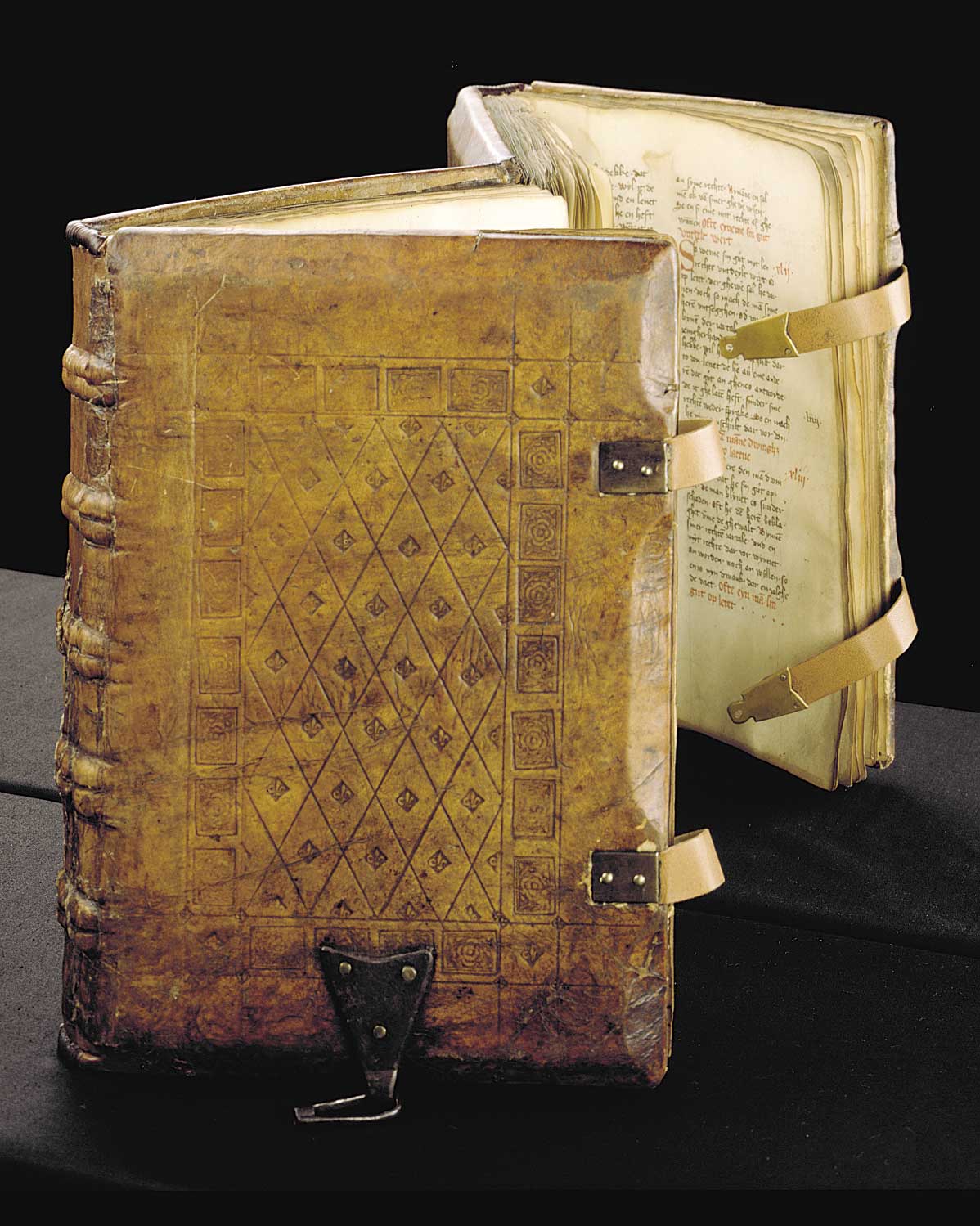
The sheets were then folded into quires and the completed books were stitched and bound to protect the manuscript. Covers usually made of thin boards of wood or sometimes pasteboard where coated next in leather, to join across the spine, the back and the front.

Quires, and below, a bound book.

Bound book.
Books available in the thirteenth century included subjects such as husbandry written by monks but based on reports by men with practical experience. In England about 6% of the population could read and write though these were mainly clerics. In France 10% of the population were literate though more of them could read than write. (Fossier; 2010; 335-40). Scientific works on medicine were also available along with books on theology, philosophy and  law as well as poetry and dictionaries and encyclopaedias. Soon saints' lives, Arthurian tales and books of everyday life were starting to appear and the wealthy were starting to buy them as well as universities. Studying at schools and universities created a market for textbooks, students renting a book of 16 columns of 62 lines each with 32 letters, for a halfpenny or a penny. This also led to the creation of a black market for books. Students would borrow books and copy them. Saint Bernard complained that a borrower had copied his book, adding before the next borrowing "although you may read it, I do not allow you to copy it" (Gies; 1981;174). Those copying would use the wax tablets and get a copier to work on the actual parchment. Of course mistakes were made and some books finished with the plea to at least copy correctly. When mistakes occurred, the copier might turn it into a little joke such as picture of a character carrying the missing word up the margin. (Gies; 1981;174 - 5.)

As to what appeared in books, tradition was so important in medieval times, that as well as colours being associated with particular subjects, there were certain images that went with tales and these could not be changed, nor could extra images be added. Images in illuminations were also symbols for certain things, making a sort of shorthand. If a building was important in a saint's life, the structure eventually became a stand in for the person, or accompanied the person. For example St Barbara usually is usually pictured between the bathhouse where she sought refuge and the tower where she was executed (Sciacca; 2010; 58). Buildings would be shown in cross sections to allow different episodes to appear within the one picture. And someone dedicating a church might well be pictured holding a miniature of that church to represent that it is their gift as well as showing final product (Sciacca; 2010; 27). 
A lavishly illustrated and bound book.
Women from wealthier families read quite a bit as their daughters were taught reading and some Latin along with their sons. These women would leave books in their wills, showing how valued these possessions were.  And we have some famous female writers. Christine de Pisan is one of the earliest known female authors. Widowed, she started up writing to support her family and ended up with her own writing and publishing business and established a reputation as a serious writer. She employed scribes and illustrators, including females. Fifty-five of her books still exist. The first of these was 'The Book of the City of Ladies - Livre de la Cite des Dames' - a book about writing and reading and designed as a foil to the male writers of that time. In the book Christine builds city where every brick is a remarkable woman. 

Hildegard of Bingen (1098 - 1179) is now recognised as a remarkable woman – a preacher, teacher, composer, writer, healer, and prophet, she was educated at and come to run the Benedictine monastery at Mount Saint Disbode. We have 72 songs by her, including a morality play set to music in which she is said to have extend the ‘vocabulary of medieval music radically beyond the norms' creating a 'highly individual and unorthodox musical style' (Thornton; 1982). We also have 70 poems, 11 books including herbal advice, biological and botanical observations, ideas on health and ailments and theological works and 2 biographies of saints and over 100 letters to emperors and popes, bishops, archbishops, nuns and nobility. She may have written the drafts but had a number of scribes of both sexes to do the writing and illuminating who took dictation and put the content into the correct Latin grammatical form. (Fox; 1985; 6.)
A current copy of one of Hildegard's books.
As to reader and book collectors, in England, the fourteenth century royals were avid book collectors. Edward II (1284 – 1327) had a collection of books including a History of kings, and his wife Isabella owned various Arthurian romances and a book on the Trojan war. They had a royal lending library in the Tower of London of about 340 books. His son Edward III, though not a great reader, collected books and paid 100 marks, now about $100 (Australian), in 1335 for a single volume. (Mortimer; 2008; 271.) In Fance, Jeanne de Laval (1433 to 1498) who was married to  King Rene d'Anjou and so was Queen of Jerusalem and Sicily, Duchess of Anjou and Bar, and Countess of Provence owned a number of books including Les Aventures de Baudouiri de Gavre and this text is known only from this one copy. It is illuminated with eighteen miniatures by an artist from the Loire valley and dates from around 1470-80. It is in the Bibliotheque Nationale on Paris. (Legare; 1996; 210 - 221.)

So who was reading books in the medieval world? The wealthier could commission and buy them, and the less wealthy may well have had access to books as who else would books on husbandry be for?  Who was writing them? This developed from monks and nuns – with knowledge from those with practical experience – to educated individuals who employed scribes for the editing, writing and illustrating and publishers to put the books together. They cover a vast range of subjects such as we would expect to find in a library now, and include one-off books that exist nowhere else as well as copies of tales we still read such as works about the Greek and Arthurian heroes.

File:Medieval-Jousting-Tournaments.jpg
References:
Bradley, JW 2006, Illuminated manuscripts, EBook #19870, e-book, Project Gutenberg, viewed 5 April 2011, <http://www.gutenberg.org/ebooks/19870>. 
Benedict K M 2005 'Empowering Collaborations: writing partnerships between religious women and scribes in the Middle Ages' in Studies in Medieval History and Culture, Gentry, F G (ed.,) Routledge New York
Bologna, G 1988, Illuminated Manuscripts: the Book before Gutenberg, Thames and Hudson, London.

De Hamel, C 1992, Scribes and Illuminators, British Museum Press, London.


Fossier, R; Cochrane, L G. 2010 The Axe and the Oath: Ordinary Life in the Middle Ages, e-book, accessed 04 May 2011, <http://swin.eblib.com.au.ezproxy.lib.swin.edu.au/patron/FullRecord.aspx?p=548758>.

Fox, M 1985 Illuminations of Hildegard of Bingen, Bear and Co, Santa Fe, New Mexico.

Gies, J & Gies, F 1981, Life in a Medieval city, Harper Perennial, New York. 
Glaister, G A 1979, Glaister's Glossary of the Book, Allen and Unwin, London.

Green, K 2010 'What Were the Ladies in the City of Ladies Reading? The Libraries of Christine de Pizan's Contemporaries' pp 77- 86 in Clogan, P M (ed.), Medievalia et Humanistica, No. 36 : Studies in Medieval and Renaissance Culture, e-book, accessed 15 May 2011, <http://swin.eblib.com.au.ezproxy.lib.swin.edu.au/patron/FullRecord.aspx?p=654154>.

Hult, DF 2003 'The Roman de la Rose, Christine de Pisan and the querelle des femmes' pp 184-194 in The Cambridge Companion to Women's Writing, Dinshaw, C and Wallace, D (eds.), Cambridge University Press, Cambridge.

Krueger, RL  2003 'Marie de Franc'e pp 172 - 183 in
The Cambridge Companion to Women's Writing,
Dinshaw, C and Wallace, D (eds.) Cambridge University Press, Cambridge.

Legare A-M. 1996 'Reassessing women’s libraries in late Medieval France : the case of Jeanne de Laval' pp 209–236 in Renaissance studies vol. 10 no. 2, The Society of Renaissance Studies, Oxford University Press, Oxford. Available as e-journal, accessed 29 April 2011, <http://onlinelibrary.wiley.com.ezproxy.lib.swin.edu.au/doi/10.1111/j.1477-4658.1996.tb00357.x/pdf>.
Malicote, Sandra  2010, Image and Imagination : Picturing the Old French Epic, e-book, accessed 17 May 2011, <http://swin.eblib.com.au.ezproxy.lib.swin.edu.au/patron/FullRecord.aspx?p=480073>.

McGuire, T 1997 ‘Two Twelfth Century Women and Their Books’, pp 96 – 105 in Women and the Book: Assessing the visual evidence, Smith, L and Taylor, JHM (eds.) The British Library London.

Mortimer, I  2008, The time traveller's guide to medieval England: a handbook for visitors to the fourteenth century, The Bodley Head, London.


Penketh, S 1997 ‘Women and Books of Hours’, pp 266 – 281 in Women and the Book : Asssessing the visual evidence, Smith, L and Taylor, JHM (eds.), The British Library, London.

Phillips, H  2007 Nature, masculinity and suffering : the remaking of the flower and leaf and chaucer’s legend of good women in the nineteenth century in Costambeys, Marios; Hamer, Andrew; Heale, Martin 2007, The Making of the Middle Ages : Liverpool Essays, e-book, accessed 20 Apr 2011, <http://swin.eblib.com.au.ezproxy.lib.swin.edu.au/patron/FullRecord.aspx?p=380582>.
Sciacca, C  2010, Building the Medieval World, The J Paul Getty Museum, Los Angeles.

Smith, L 1997 'Scriba, femina: Medieval depictions of women' pp 21 - 44 in Women and the Book : Asssessing the visual evidence, Smith, L and Taylor, JHM (eds.), The British Library, London.

Smith, L and Taylor, JHM  1997 Introduction pp 13- 18 in
Women and the Book : Asssessing the visual evidence, Smith, L and Taylor, JHM (eds.). The British Library, London.
Summit, J  2003 'Women and authorship' pp 91 - 108 in The Cambridge Companion to Women's Writing, Dinshaw, C and Wallace, D (eds.) Cambridge University Press, Cambridge.
Thornton, B  1982 “The musical conception of Ordo Virtutum” notes accompanying the record Hildegard of Bingen: Ordo Virtutum, Sequentia Ensemble für Musik des Mittelalters, WDR Producer, EMI Electrola,Cologne, Germany, in Fox, M 1985 Illuminations of Hildegard of Bingen, Bear and Co, Santa Fe, New Mexico.

 
Images


'Bound book', image, viewed 23 May 2011, <http://commons.wikimedia.org/w/index.php?title=Special:Search&limit=20&offset=40&ns0=1&ns6=1&ns12=1&ns14=1&ns100=1&ns106=1&redirs=1&search=medieval+book>

'Illuminated page', image, viewed 23 May 2011,<http://commons.wikimedia.org/w/index.php?title=Special3ASearch&redirs=1&search=medieval+st+jerome&fulltext=Search&ns0=1&ns6=1&ns12=1&ns14=1&ns100=1&ns106=1&uselang=en>

'Hildegard's healing plants cover', image, viewed 23 May 2011 <http://gherkinstomatoes.com/2009/07/27/the-random-herbalist-books-about-monastic-and-medievaol-gardens/>

'Illustrated and bound book', image, viewed 23 May 2011  <http://realfoodfarming.com/blog>

'Jousting knights', image, viewed 23 may 2011, http://commons.wikimedia.org/w/index.php?title=Special:Search&limit=20&offset=20&ns0=1&ns6=1&ns12=1&ns14=1&ns100=1&ns106=1&redirs=0&search=medieval+knight+

'Medieval breviary', image, viewed 23 May 2011, <http://www.fromoldbooks.org/Search/?kw=illumination>

'Quires', image, viewed 23 May 2011 <http://classical-bookworm.blogspot.com/2006/01/making-art-medieval-manuscripts_9686.html>

'Woman writing', image, viewed 23 May 2011, <http://www.fromoldbooks.org/Search/?kw=illumination>


Video

'Medieval illumination', video, viewed 22 May 2011, <http://www.youtube.com/watch?v=CYa7GRVsyEU>


Sunday, 22 May 2011

What were people writing and reading?

What was being written and read in medieval times?

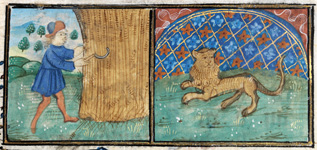
Before 1200 books were produced on husbandry in Normandy, England and Italy. These were called ‘houseboundaries’ and were written by monks though based on reports by men with practical experience. In England in 1450, 20 000 out of 3 million population could read and write – mainly clerics. In France this was 10%. More of them could read than write. (Fossier; 2010; 335-40).
This image is from the De Grey Book of Hours - there's a link to this on the right of the screen. There's quite a collection of 'working the land' images .
Medieval documents such as inventories of books as well as wills show who owned what books – at least among the classes that kept an inventory and wrote wills. They show that royals, nobles and the bourgeois families owned manuscripts and printed books, sometimes enough for a whole library of books. And such documents of women in particular show who was buying, using and played a part in the conservation of books from that time.

Margaret of Austria (the god-daughter of Margaret of York) had a library of almost 400 books in Flanders. Louise de Savoie (mother of Francois I of France) chose books for her son and commissioned new works. Anne de Bretagne owned many manuscripts that stand out as having extraordinary calligraphic and artistic qualities some of which would have been commissioned by her. Recently facts have come to light about the collection of one of her close friends, Jeanne de Laval which I have looked at even though she was alive quite late in the Middle Ages (Legare; 1996; 209-10) as it was great to find an inventory of someone’s books.

Jeanne lived from1433 to 1498.She was the daughter of Guy XIV de Laval and Isabelle de Bretagne and as she married King Rene d'Anjou in 1454 and became Queen of Jerusalem and Sicily, Duchess of Anjou and Bar, and Countess of Provence she was rather higher up in the social scale than the type of person I wanted to be looking at. Her husband was an important patron of writers and illuminators, the theatrical arts and painting. His library was one of the largest belonging to a French prince during the fifteenth century. Jeanne owned rather less books but we know amongst these was a Psalter, her Book of Hours, and her Breviary which she left along with all her other books to the daughters of the Laval family, continuing the tradition of female education. She owned a Life of St Denis from 1317, in 3 volumes, and a Life of Saints. The article Reassessing women’s libraries in late medieval france : the case of Jeanne de Laval in Renaissance studies vol 10 no 2 contains the list of  ten manuscripts that belonged to Jeanne. One of these is especially important - Les Aventures de Baudouiri de Gavre as this text is known only from this copy. It is illuminated with eighteen miniatures by an artist from the Loire valley and dates from around 1470-80. It is in the Bibliotheque Nationale on Paris. (Legare; 1996; 210 - 221.) How exciting it would be to come across this in an inventory and find it had never appeared in anyone else's.

In England, the fourteenth century royals were avid book collectors. Edward II (1284 – 1327) had a collection of books including a History of kings, and his (not so loving) wife isabella owned various Arthurian romances and a book on the Trojan war. They had a royal lending library in the Tower of London of about 340 books. His son Edward III, though not a great reader, collected books and paid 100 marks, now about $100 (Australian), in 1335 for a single volume. (Mortimer; 2008; 271). A lot of the inventories contained Arthurian adventures and the story of the Trojan war which was pleasing as they were so recognisable to us here and now. So many of the rest of the list are now little known or only known to the academic community.

In France, Philippe VI's 1st wife Jeanne la Boiteuse de Bourgogne (1293 – 1348) comissioned  French translations from the Latin of various manuscripts including Ovid's Metamorphoses. She left her 41 volumes, some containing multiple works, to various relatives. (Green; 2011;80.) Valentina Visconti, the mother of Charles of Orleans (1391–1465) brought 18 books with her when she came to France in 1388 including a history of Troy. This collection grew to about 30 works by the time she died in 1408.(Green; 2011;82.)

Medieval devices – in words and pictures

As to what appeared in books, tradition was so important in medieval times, that as well as colours being associated with particular subjects, there were certain images that went with tales and these could not be changed, nor could extra images be added. Images in illuminations were also symbols for certain things, making a sort of shorthand. If a building was important in a saint's life, the structure eventually became a stand in for the person, or accompanied the person. For example St Barbara usually is usually pictured between the bathhouse where she sought refuge and the tower where she was executed Sciacca; 2010; 58) - quite grisly and poignant. Buildings would be shown in cross sections to allow different episodes to appear within the one picture. And someone dedicating a church might well be pictured holding a minaiture of that church to represent that it is their gift as well as showing final product(Sciacca; 2010; 27).


[St. Barbara] (f. 35v)
Saint Barbara
There were also symbols within the stories themselves, such as in The Flower and the Leaf from the fifteenth century where the flower symbolises idleness, pleasure and beauty while the leaf stands for effort self control and chastity. The Leaf team is led by Diana (not surprisingly, as the qualities reflect her traditional Roman virtues) and her knights compete in a tournament while the flower knights and ladies, led by Flora, are drenched and burned by the rain and sun and have to be rescued by the leaf knights. The whole is a vision by a female narrator who when asked to choose, quite sensibly chooses the leaf team to ally herself with. This reflects how chivalric orders were popular at the time. John of Gaunt’s daughter Phillippa (John being Edward III’s third son) apparently had a flower group of her own, (Phillips; 2007; 72-3) which sounds right as the whole thing seems rather teenage and perhaps choosing flower over leaf shows her relaxed upper-classishness as well as rebellious-daughter-of-important-man.


Flower or Leaf images.


This is a video with an array of manuscript images

and one on bookmaking.

This will be the last post before the final report. I have tended to rely on books, some online, and also many journal articles online. If I wanted to write an academic paper on the details of readers and writers, especially women, from that time, these articles are where I would go. But for the more general exploration of the subject, it was great to have physical books with the well-produced images. 

Next will be my report in which I've kept the basic information I've found. I did end up extending my topic to book in general, rather than who owned books which became a little academic but I feel satisfied with the general feel I now have for medieval books - the writers and readers. There are more details of soem of these in the actual blogs than there will be in my report. There's one book for which I still need to get the page references - I've ordered the book from a library as I didn't realise we were keeping such detailed references.
References:

Fossier, R; Cochrane, L G. 2010 The Axe and the Oath : Ordinary Life in the Middle Ages, e-book, accessed 04 May 2011, <http://swin.eblib.com.au.ezproxy.lib.swin.edu.au/patron/FullRecord.aspx?p=548758>.

Green, K 2010 'What Were the Ladies in the City of Ladies Reading? The Libraries of Christine de Pizan's Contemporaries' pp 77- 86 in Clogan, P M (ed), Medievalia et Humanistica, No. 36 : Studies in Medieval and Renaissance Culture, e-book, accessed 15 May 2011, <http://swin.eblib.com.au.ezproxy.lib.swin.edu.au/patron/FullRecord.aspx?p=654154>.
Legare A-M.  1996 'Reassessing women’s libraries in late Medieval France : the case of Jeanne de Laval' pp 209–236 in Renaissance studies vol. 10 no. 2, The Society of Renaissance Studies, Oxford University Press, Oxford. Available as e-journal, accessed 29 April 2011,<http://onlinelibrary.wiley.com.ezproxy.lib.swin.edu.au/doi/10.1111/j.1477-4658.1996.tb00357.x/pdf>.
Malicote, Sandra 2010, Image and Imagination : Picturing the Old French Epic, e-book, accessed 17 May 2011, <http://swin.eblib.com.au.ezproxy.lib.swin.edu.au/patron/FullRecord.aspx?p=480073>.

Mortimer, I  2008, The time traveller's guide to medieval England: a handbook for visitors to the fourteenth century, The Bodley Head, London.
Phillips, H  2007 Nature, masculinity and suffering : the remaking of the flower and leaf and chaucer’s legend of good women in the nineteenth century in Costambeys, Marios; Hamer, Andrew; Heale, Martin 2007, The Making of the Middle Ages : Liverpool Essays, e-book, accessed  20 Apr 2011, <http://swin.eblib.com.au.ezproxy.lib.swin.edu.au/patron/FullRecord.aspx?p=380582>.


Sciacca, C  2010, Building the Medieval World, The J Paul Getty Museum, Los Angeles.

Images
Flower or Leaf, image, viewed 16 May 2011, <http://www.loc.gov/exhibits/bnf/images/bnf027.jpg>Peasants working, image, De Grey Book of Hours, viewed 22 May 2011, <http://digidol.llgc.org.uk/METS/ODG00001/logical?start=1&locale=en>
Peasants working, image, De Grey Book of Hours, viewed 22 May 2011, <http://digidol.llgc.org.uk/METS/ODG00001/logical?start=1&locale=en>
Saint Barbara, image, De Grey Book of Hours, viewed 22 May 2011, <http://digidol.llgc.org.uk/METS/ODG00001/logical?mode=reference&item=19&locale=en>

Videos

The production of medieval manuscripts, viewed 22 May 2011, video, <http://www.youtube.com/watch?v=dhQ8Um221Eo>
Medieval books in the digital age, viewed 15 May 2011, video,<http://www.youtube.com/watch?v=iiOCE07doi4>

Saturday, 14 May 2011

Hildegard of Bingen and other women writers

I had counted on looking into the life and works of Hildegard of Bingen and here she is with her impressive list of accomplishments. Ages ago, looking at a book of biographies, the word defining her was 'Saint' which struck me as a terrific claim to fame. In my latest reading, Hildegard of Bingen (1098 - 1179) is described in many places as 'a twelfth century visionary and abbess'. The image of her below is a recurring detail from many of her works where she is pictured seated in the bottom left hand corner writing her visions and ideas which unfold above her. She may have written the drafts but had a number of scribes of both sexes to do the writing and illuminating. The most famous of these was a young monk named Volmar who took dictation and put the content into the correct Latin grammatical form. People have over the years suggested that he took liberties with her writing, but in later years she commended his accuracy in one of her other books written by a different scribe. Given that someone is dictating and someone else writing it out, it's hard to know where the truth about Volmar or any scribe really lies.
  
Hildegard of Bingen
I've constructed a sort of resume for her:

Skills and experiences - preaching, teaching; organising, reforming and establishing monasteries, journeying, composing, writing, healing, studying and prophecying (Matthew Fox; 1985;6).

Works -
  • Over 100 letters to emperors and popes, bishops, archbishops, nuns and nobility.
  • 72 songs including a morality play set to music for which she has been recently accalimed for 'extending the vocabularyof medieval music radically beyond the norms' and for creating a 'highly individual and unorthodox musical style'  (Matthew Fox; 1985;6). One of her arrangements features below.
  • 70 poems.
  • 11 books including herbal advice, biological and botanical observations, ideas on health and ailments and theological works and 2 biographies of saints (Matthew Fox; 1985;6).

If you follow this link you can find a whole heap of her music. http://www.youtube.com/artist?a=GxdCwVVULXekdE3RP36VUpaWHTeajNso&feature=watch_video_title

A timeline of her life:
1098 born - educated at local benedictine monastary at Mount Saint Disbode
1106 went to live there
1116 took over the running of the female community there
1140 had a vision, started to write
1140-50  worked on first book Scrivas ('Know the ways'). The Pope came to visit her to check the authenticity of her visions and encouraged her to keep writing. During this time she also reformed churches including the physical building and founded another monastery. (Matthew Fox; 1985;6).

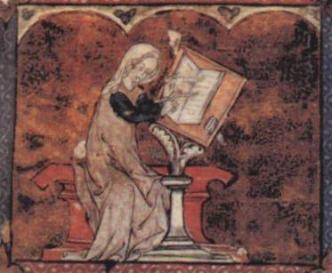
The names of other female writers - as I said in an earlier blog, these are far easier to find than men - apart from Christine de Pisan who I looked at in the last blog, I came across Marie de France from 1100s who translated King Alfred's English version of Aesops Fables. But there is some controversy about her. Till quite recently people wondere if she was one person or many. Was she female even? The sources I looked at agreed she was female - except for one male writer and it was hard for me not to poo-pooh his clinging to an old view.

Marie de France
Birgitta of Sweden (1302 - 1373) is another one I came across a few times. She too is a saint. She is apparently always portrayed writing (Smith; 1997; 40). She had a great attachment to Mary mother of Christ and set up a separate order dedcated to her, with its own rules. It is know that Birgitta's scribes read aloud to her to make sure the words were the ones she had dictated (Benedict; 2005).

Other female writers worth mentioning - Margery Kempe and Angela of Foligno. I haven't looked into them as I'm ready to move onto what books people owned.
Birgitta of Sweden
Here is Birgitta, and indeed she is continuing to write despite her illustrious company.


References:

Benedict K M  2005 'Empowering Collaborations: writing partnershipsbetween religious women and scribes in the Middle Ages' in Studies in Medieval History and Culture, Gentry, F G (ed.) Routledge New York.

Fox, M  1985 Illuminations of Hildegard of Bingen, Bear and Co, Santa Fe, New Mexico.

Hult, DF  2003 'The Roman de la Rose, Christine de Pisan and the querelle des femmes' pp 184-194 in The Cambridge Companion to Women's Writing, Dinshaw, C and Wallace, D (eds.) Cambridge University Press, Cambridge.

Krueger, RL  2003 'Marie de Franc'e pp 172 - 183 in  in The Cambridge Companion to Women's Writing, Dinshaw, C and Wallace, D (eds.) Cambridge University Press, Cambridge.

Smith, L 1997 'Scriba, femina: Medieval depictions of women' pp 21 - 44 in Women and the Book : Asssessing the visual evidence, Smith, L and Taylor, JHM (eds). The British Library, London.

Smith, L and Taylor, JHM  1997 Introduction pp 13- 18 in Women and the Book : Asssessing the visual evidence, Smith, L and Taylor, JHM (eds). The British Library, London.

Summit, J  2003 'Women and authorship' pp 91 - 108 in The Cambridge Companion to Women's Writing, Dinshaw, C and Wallace, D (eds.) Cambridge University Press, Cambridge.

Thornton, B  1982 “The musical conception of Ordo Virtutum” notes accompanying the record Hildegard of Bingen: Ordo Virtutum, Sequentia Ensemble für Musik des Mittelalters, WDR Producer, EMI Electrola,Cologne, Germany, in Fox, M 1985 Illuminations of Hildegard of Bingen, Bear and Co, Santa Fe, New Mexico.


images

Marie de France, image, Wikimedia Commons, viewed 14 May 2011,  <http://commons.wikimedia.org/wiki/File:Marie_de_France_illuminated.jpeg>

Birgitta of Sweden, image, viewed 8 May 2011, <http://media.kunst-fuer-alle.de/img/41/m/41_00570702~st--bridget-of-sweden---illumination.jpg>

Hildegard of Bingen, image, viewed 4 May 2011, <https://blogger.googleusercontent.com/img/b/R29vZ2xl/AVvXsEivqaIq8QPAUzJNkg2ZJ-6wAalmHAhEr-5bjHmtfISGnyJSlWKkEvzrtnrreD5njL3VjTrcw_KFWbrY5QtXNwe1J-_S9B5SwdW5nx2wOX86aYXMYPZX_7TQKUEVTeuQ8A9PyIXqL7c6pmY/s1600/hildegard_von_bingen8.jpg>  at <http://blackfishart.blogspot.com/2010/10/hildegard-von-bingen-medieval-visonary.html>

Audio/video

Hildegard von Bingen - Kyrie Eleison, viewed 14 May 2011 <http://www.youtube.com/watch?v=8yXJ0MDTI4Q>
 
Music by Hidegard of Bingen, list on YouTube, viewed 14 May 2011, <http://www.youtube.com/artist?a=GxdCwVVULXekdE3RP36VUpaWHTeajNso&feature=watch_video_title

Sunday, 8 May 2011

Women writing, illustrating and publishing.


Since I started this project I was on the look-out for a picture of someone in the secular world with books and this was the first I came across. There were plenty of monastic people with books and Mary (mother of Jesus) is often shown reading a book. These ladies here obviously own at least three books - though 4 out of 6 of the women also wear crowns so they have to money to own them. Then I found out more about the piece. It's "Ladies Building their City" by Christine de Pisan, one of the earliest known female authors. And the picture is from the "Book of the City of Ladies" (Paris 1410-14). The picture is supposed to be Christine in the blue, discussing her plans with Rectitude, Reason and Justice. The second panel shows Christine working with Justice to do the actual brickwork and the method is quite typical way of the way building is shown in other illuminations of the same time.

As there has been recent attention to female writers it was actually much easier to find information on women than on men and women. So I let that lead me to do just that. The only name of a writer I knew was Hildegard of Bingen, so that tied in anyway.

It is apparently quite difficult to tell authorship in writing from that time. And women, at any rate, tended to write in such a way that it was hard to tell who was the actual writer - who did the thinking and writing, who collected the writings together. Widowed, Christine de Pisan started up writing to support her family and ended up with her own writing and publishing business and established a reputation as a serious writer. She employed scribes and illustrators, including females. Fifty-five of her books still exist and I think the first of these was 'The Book of the City of Ladies - Livre de la Cite des Dames' - a book about writing and reading and designed as a foil to the male writers of that time. In the book Christine builds city where every brick is a remarkable woman. Her final work was the Tale of Joan of Arc in 1429, so she was writing of a contemporary.

Apparently though, there are quite a few pictures of women with books, people have wondered whether they are reading them or just own them. Books were such intricate things, often given as wedding presents and were kept with people's jewellery and could easily have been decorative rather than useful items. There is a picture of Mary of Burgundy reading a book of hours, showing a woman actually using a book. Also The Book of Goodman of Paris (c.1393) was written for his wife to read. So women from wealthier families probably read quite a bit as their daughters were taught reading and some Latin along with their sons. And since we have the names of a handful of women writers it would make sense that they read and hence decided to write.

As to writing the actually manuscripts out, the contents of these show that scribes often had no idea what they were writing, so a woman could have been a scribe as much as a man.  Nuns were scribes as they made their own books the same as monks though little is known about them. Anglo-Saxon women seem to have been freer to write and compose than these later women.

The women writers:

Christine de Pisan
Hildegard of Bingen
Marie de France
Baudonina
St Bridget of Sweden
Herrad of Landsberg / Hohenburg

I'll look at a few of these if I can.

Then I came across a work asking about what books the ladies in the City of Ladies were reading. The books Christine de Pisan used in her works were available on the libraries of her females she knew -  friends and patrons, so the works she mentions and the women in her city would have been people readers of the French court knew about. The women she mentions such as Blanche (1328-92) married to the Duke of Orleans, duchess Marie d'Anjou (1345-1407) and the countess de la Marche (who died in 1412) would have possessed collections of books. So these are some of the collectors I am looking for - all titled individuals. These women would leave books in their wills, showing how jewel-like these possessions were. For example Blanche of Navarre who had been left a book by Blanche d'Orleans, eventually had quite a collection which she in turn left to people in her will. The first of these givers - Blanche d'Orleans - mentions four books in her will, making her the closest so far to my title of 'Item 3 Books'. Though she may have had lots of others she didn't feel needed mentioning.

References:

Green, K  2010 'What Were the Ladies in the City of Ladies Reading? The Libraries of Christine de Pizan's Contemporaries' pp 77- 86 in Medievalia et Humanistica, No. 36 : Studies in Medieval and Renaissance Culture, Clogan, PM (ed), Rowman and Littlefield, Lanham.

Hult, DF  2003 ‘The Roman de la Rose, Christine de Pisan and the querelle des femmes’ pp 184-194 in The Cambridge Companion to Women's Writing, Dinshaw, C and Wallace, D (eds), Cambridge University Press, Cambridge.

Krueger, RL  2003 ‘Marie de France’ pp 172 - 183 The Cambridge Companion to Women's Writing, Dinshaw, C and Wallace, D (eds), Cambridge University Press, Cambridge.

McGuire, T  1997 ‘Two Twelfth Century Women and Their Books’, pp 96 – 105 in Women and the Book : Asssessing the visual evidence, Smith, L and Taylor, JHM (eds) The British Librar,y London.

Penketh, S  1997 ‘Women and Books of Hours’, pp 266 – 281 in Women and the Book : Asssessing the visual evidence, Smith, L and Taylor, JHM (eds), The British Library, London.

Sciacca, C  2010, Building the Medieval World, The J Paul Getty Museum, Los Angeles.

Smith, L  1997 ‘Scriba, Femina : Medieval Depictions of Women Writing’, pp 21- 44 in Women and the Book : Asssessing the visual evidence, Smith, L and Taylor, JHM (eds), The British Library London.

Smith, L and Taylor, JHM (eds)  1997 Introduction pp 13- 18 to Women and the Book : Asssessing the visual evidenc, The British Library. London.

Summit, J  2003 ‘Women and Authorship’ pp 91 - 108 in The Cambridge Companion to Women's Writing Dinshaw,C and Wallace, D (eds.), Cambridge University Press, Cambridge.

image of the City of Ladies from De Pisan, C 1414 The book of the city of ladies http://www.jeanne-darc.info/img_miscellaneous/0_panoramas/pisan_cite_des_dames.jpg